Free PDF An Uncertain Glory: India and its Contradictions, by Jean Drèze, Amartya Sen
It can be one of your morning readings An Uncertain Glory: India And Its Contradictions, By Jean Drèze, Amartya Sen This is a soft data book that can be got by downloading from on the internet book. As understood, in this advanced age, modern technology will certainly alleviate you in doing some tasks. Even it is simply checking out the visibility of publication soft file of An Uncertain Glory: India And Its Contradictions, By Jean Drèze, Amartya Sen can be additional attribute to open. It is not only to open as well as save in the gadget. This time around in the early morning as well as various other free time are to read the book An Uncertain Glory: India And Its Contradictions, By Jean Drèze, Amartya Sen
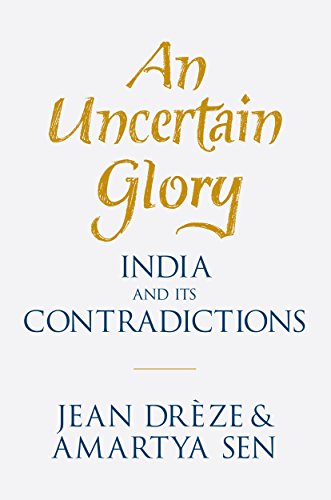
An Uncertain Glory: India and its Contradictions, by Jean Drèze, Amartya Sen

Free PDF An Uncertain Glory: India and its Contradictions, by Jean Drèze, Amartya Sen
Exactly how if your day is started by checking out a publication An Uncertain Glory: India And Its Contradictions, By Jean Drèze, Amartya Sen However, it is in your gizmo? Everybody will certainly always touch and us their device when waking up and in morning activities. This is why, we suppose you to likewise check out a publication An Uncertain Glory: India And Its Contradictions, By Jean Drèze, Amartya Sen If you still confused ways to obtain guide for your gadget, you could follow the means right here. As below, we offer An Uncertain Glory: India And Its Contradictions, By Jean Drèze, Amartya Sen in this web site.
Maintain your method to be below and read this resource finished. You could appreciate searching guide An Uncertain Glory: India And Its Contradictions, By Jean Drèze, Amartya Sen that you truly describe obtain. Right here, getting the soft file of the book An Uncertain Glory: India And Its Contradictions, By Jean Drèze, Amartya Sen can be done effortlessly by downloading in the web link page that we offer below. Of course, the An Uncertain Glory: India And Its Contradictions, By Jean Drèze, Amartya Sen will certainly be yours quicker. It's no should await guide An Uncertain Glory: India And Its Contradictions, By Jean Drèze, Amartya Sen to get some days later after acquiring. It's no need to go outside under the heats at center day to head to the book establishment.
This is a few of the benefits to take when being the member and also get the book An Uncertain Glory: India And Its Contradictions, By Jean Drèze, Amartya Sen right here. Still ask just what's different of the other site? We provide the hundreds titles that are produced by suggested authors and also publishers, worldwide. The connect to acquire and download An Uncertain Glory: India And Its Contradictions, By Jean Drèze, Amartya Sen is additionally extremely easy. You might not locate the complicated site that order to do more. So, the method for you to obtain this An Uncertain Glory: India And Its Contradictions, By Jean Drèze, Amartya Sen will be so very easy, won't you?
Based on the An Uncertain Glory: India And Its Contradictions, By Jean Drèze, Amartya Sen details that we offer, you may not be so confused to be below and to be participant. Get now the soft file of this book An Uncertain Glory: India And Its Contradictions, By Jean Drèze, Amartya Sen and also save it to be your own. You saving could lead you to stimulate the convenience of you in reading this book An Uncertain Glory: India And Its Contradictions, By Jean Drèze, Amartya Sen Also this is types of soft data. You can truly make better chance to get this An Uncertain Glory: India And Its Contradictions, By Jean Drèze, Amartya Sen as the suggested book to read.
When India became independent in 1947 after two centuries of colonial rule, it immediately adopted a firmly democratic political system, with multiple parties, freedom of speech, and extensive political rights. The famines of the British era disappeared, and steady economic growth replaced the economic stagnation of the Raj. The growth of the Indian economy quickened further over the last three decades and became the second fastest among large economies. Despite a recent dip, it is still one of the highest in the world.
Maintaining rapid as well as environmentally sustainable growth remains an important and achievable goal for India. In An Uncertain Glory, two of India's leading economists argue that the country's main problems lie in the lack of attention paid to the essential needs of the people, especially of the poor, and often of women. There have been major failures both to foster participatory growth and to make good use of the public resources generated by economic growth to enhance people's living conditions. There is also a continued inadequacy of social services such as schooling and medical care as well as of physical services such as safe water, electricity, drainage, transportation, and sanitation. In the long run, even the feasibility of high economic growth is threatened by the underdevelopment of social and physical infrastructure and the neglect of human capabilities, in contrast with the Asian approach of simultaneous pursuit of economic growth and human development, as pioneered by Japan, South Korea, and China.
In a democratic system, which India has great reason to value, addressing these failures requires not only significant policy rethinking by the government, but also a clearer public understanding of the abysmal extent of social and economic deprivations in the country. The deep inequalities in Indian society tend to constrict public discussion, confining it largely to the lives and concerns of the relatively affluent. Dr�ze and Sen present a powerful analysis of these deprivations and inequalities as well as the possibility of change through democratic practice.
- Sales Rank: #853065 in Books
- Published on: 2015-03-22
- Original language: English
- Number of items: 1
- Dimensions: 8.90" h x 1.00" w x 5.80" l, .0 pounds
- Binding: Paperback
- 448 pages
Most helpful customer reviews
15 of 19 people found the following review helpful.
Necessity of Social Intervention accompanying Economic Growth
By Vibhash Sureka
"An uncertain Glory" is a seriously argued book advocating Social Intervention in the fields of health, education, nutrition, provision of public services like drinking water, sanitation etc. while pursuing policies of economic growth. The argument is supported by a wealth of data in a Statistical Appendix of about 40 pages.
Authors begin with a survey of India's many political and economic achievements and failures. They praise the success of formal democracy and high economic growth while lamenting the poor practice of democracy and slow progress in indicators of human well being which they rightly claim to be inter related.
The book studies India's comparative standing vis-�-vis other Asian, African and South American economies over time and establishes convincingly that despite high economic growth, India has fallen behind these countries by not paying sufficient attention to social intervention in the fields listed above.
The centrality of education and primacy of health care are further supported by success of some Indian states like Kerala, Tamilnadu and Himachal Pradesh which have achieved high level of indicators of human well being without being at the top of economic growth chart.
Authors commend the introduction and success of laws like Right to Information
and NAREGA which have brought about more transparency and accountability in political sphere and raised real wages in rural India respectively.
More importantly, India's multi dimensional inequality based on class, caste, gender and even knowledge of English are discussed and their inter relationship brought to fore.
Authors justifiably criticize the media for not paying enough attention to real issues facing the country and utilizing their resources for mainly airing the views of affluent classes. This causes severe deficiency in public reasoning and participatory development accentuating the existing inequalities.
The greatness of the work lies in its multi dimensional approach, forceful argument and well researched empirical support for the argument. It is more than successful in establishing importance of social intervention as well as a deliberative democracy for achieving greater equality in enjoyment of fruits of growth.
6 of 7 people found the following review helpful.
The Need for Impatience
By B.Sudhakar Shenoy
India is acclaimed as the world's largest democracy and the second fastest growing economy, with a huge demographic dividend and the largest middle class. Personally, I too have been a beneficiary of this rapid economic transformation since 1991.
I have always felt proud of such economic success, blindly believing in `the trickle-down effect' and that the welfare measures of the government would take care of poverty alleviation.
This book, a real eye opener, gives a totally different picture, ugly, sad, but true and accurate, of the other side of India - the poor and underprivileged, who are hungry, malnourished, illiterate and sick.
It is shocking to see the huge disparity between the privileged and the rest. Indian media, in all TV channels recently ridiculed the Planning Commission's notion of poverty line (at Rs 32/- or 5 Cents in urban areas, and Rs 26/- or 4 Cents in rural areas) as the daily income. The entire noise and laughter was on how misplaced this calculation was, since Rs 32/- meant next to nothing for survival, leave alone `luxuries' like health care and education.
The authors very rightly point out in this book, that what the entire debate grossly missed was the fact that even at the abysmal threshold of Rs 32/26/- per day, about 350 million or a third of the entire nation would still be classified as poor in the world's largest democracy.
While India can claim economic laurels on Growth rate, it is now the second lowest (thankfully) just above Pakistan in Human Development Index, amongst 16 poorest countries outside Sub-Saharan Africa as pointed out in the book.
The country has failed to harness `constructive role of markets' and simultaneously, and quite miserably in implementing `constructive role of the state'. While the former did nothing to make growth inclusive, the latter is a story of gross ineptitude, corruption and lack of accountability of the public services.
The book discusses the plight of the underprivileged, the women, Dalits and other poorer segments that are largely untouched by economic progress achieved by the privileged classes.
A chapter each on Corruption, Health Care, Education, and Social Support makes this book an exhaustive study on the ground reality of poverty in the world's largest democracy. Lots need to be done to achieve social and economic democracy as well. Democracy is just a political means to achieve social and economic justice for all.
The book discusses direct social benefit schemes like Right to Education, MNREGA, ICDS, RBSY, PDS, Food Security etc., which are bold and brilliant steps, absolutely necessary to mitigate the suffering of the poor, and also to build human capital to accelerate growth.
In my own observation, for every scheme that is announced by the Government, the privileged, due to better education, income, connections, and bargaining power corner the benefits that are actually meant and targeted for the poor. As an example, even the highly educated professionals are quick to obtain `Aadhar Card', only to avail pittance (in comparison with their gross incomes) of a subsidy for cooking gas.
The proverbial `Ration card', (taken `just in case it is needed') and Voter ID (hardly exercised by the affluent) are other examples, of proliferation of cards that adds to the confusion.
In the absence of clear communication on the purpose of these cards and schemes, and the lack of authentic data and machinery to identify the real beneficiaries, benefits meant for the poor never reach them and are siphoned out in part. The poor suffer from `exclusion error'.
The privileged enjoy regressive subsidies, and actually encourage siphoning subsidies by corrupt officials due to `inclusion error'. (For example food grains `accounted as distributed' for those who never collect them, nor would ever use them due to `poor quality'.)
The privileged also hinder inclusive growth while enjoying several regressive subsidies, in the absence of "Self Selection" systems that discourages them. (Noon meal scheme for children in Government run Schools as an example). This is my personal inference from this book.
Corruption is the biggest menace facing India. It thrives due to 1. Complex Government processes, 2. Social tolerance of bribes, and 3. Difficulty in prosecuting corrupt government officials, argue the authors.
Every honourable citizen should muster the courage to say NO to corruption, direct or indirect, whatever the social pressures. Corruption in any form erodes the national fabric, and should be treated on par with `Waging War against Nation' as pointed out recently by some social activists.
The Right to Information Act (2005) is perhaps the greatest step in this direction, to bring transparency in governance. There is a need to extend it to Private Sector and political parties as well.
It should also be noted that States like Kerala, Tamil Nadu and Himachal Pradesh have made rapid strides in Human Development Index along with rise in per capita income, while many other states have miserably failed. Informed will of the people, an efficient bureaucracy and strong political leadership, can make this huge difference.
India has always boasted of its `patience'. Aptly quoted in the final chapter of this book, "Patience is a minor form of despair, disguised as a virtue": Ambrose Bierce, in The Devil's Dictionary (1906).
India got political freedom from British, only because her patience ran out.
We can no longer be patient.
We need passion for growth, coupled firmly with compassion for the poor.
Supported by appropriate and accurate data, references and a passion for ending poverty, this book is perhaps the best, I have ever read on Indian Economics.
I LOVE INDIA. JAI HIND!
5 of 6 people found the following review helpful.
Well worth the read
By Christopher Junker
Mildly repetitive and inevitably somewhat dry, nevertheless well worth the read if you want to understand why India is not the juggernaut that many, especially in the right wing press, have been warning us about. Oddly enough, this book is rather informative about our own country in the sense that we get so see what the US would look like if the Republican/Tea Party was able to fulfill its plan of unfettered industrial growth, education for the working people neglected and complete privatization of medical care. The US is not in any real danger of falling into deep, mass poverty but the description of policy decisions and their consequences by the authors cannot but remind readers of the politics of deeply red states like Alabama and Mississippi.
An Uncertain Glory: India and its Contradictions, by Jean Drèze, Amartya Sen PDF
An Uncertain Glory: India and its Contradictions, by Jean Drèze, Amartya Sen EPub
An Uncertain Glory: India and its Contradictions, by Jean Drèze, Amartya Sen Doc
An Uncertain Glory: India and its Contradictions, by Jean Drèze, Amartya Sen iBooks
An Uncertain Glory: India and its Contradictions, by Jean Drèze, Amartya Sen rtf
An Uncertain Glory: India and its Contradictions, by Jean Drèze, Amartya Sen Mobipocket
An Uncertain Glory: India and its Contradictions, by Jean Drèze, Amartya Sen Kindle
Tidak ada komentar:
Posting Komentar